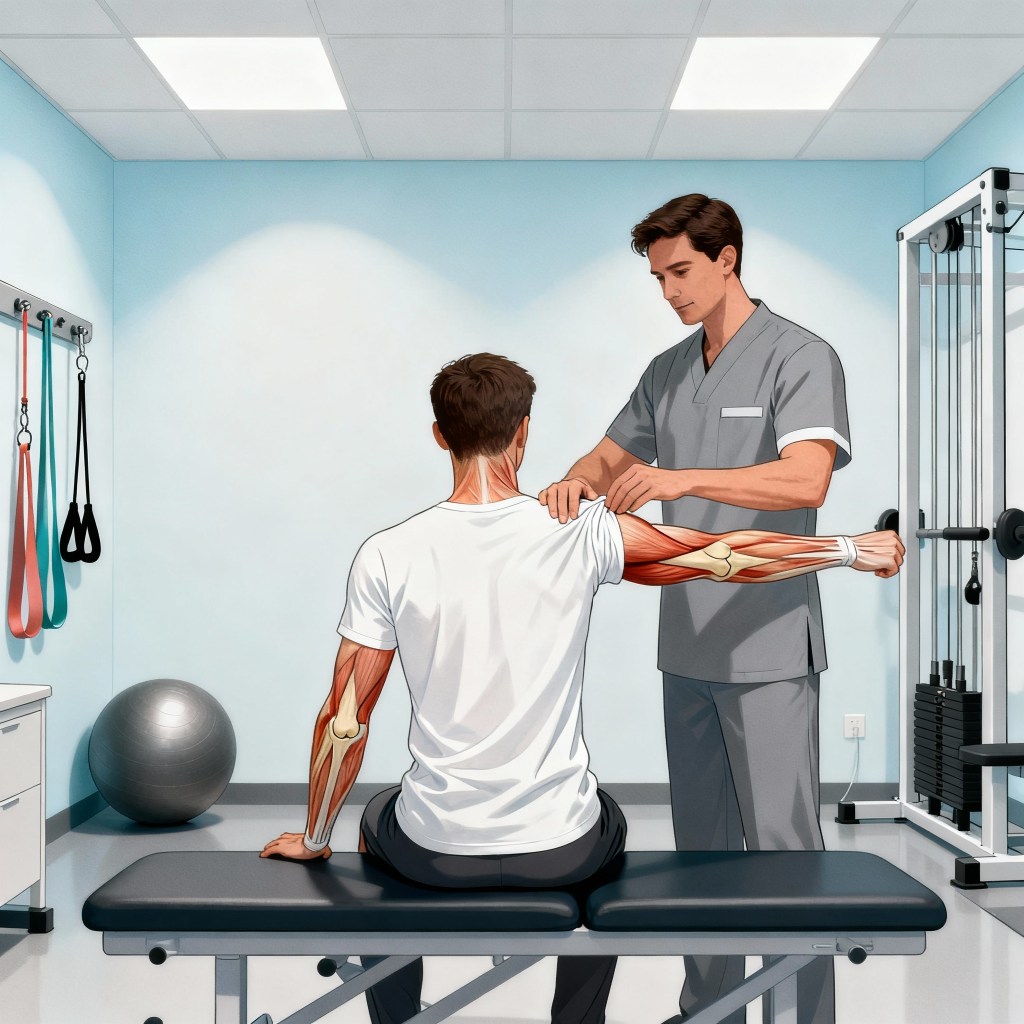
Rotator cuff tendinopathy is one of the most common causes of shoulder pain—affecting patients of all ages, backgrounds, and activity levels. The newly published 2025 Clinical Practice Guideline offers clear evidence-based recommendations to help patients and providers achieve the best outcomes with nonsurgical rehab, medical care, and return-to-activity strategies.jospt
Overview: Rotator Cuff Tendinopathy Diagnosis & Scope
Rotator cuff tendinopathy refers to disorders involving the supraspinatus, infraspinatus, subscapularis, and teres minor tendons, with or without calcifications or partial tears. Symptoms often include pain with arm elevation, loss of range of motion, and sometimes night pain. Key risk factors include repetitive movements (sports, job tasks), age-related tendon changes, poor shoulder mechanics, and psychosocial factors like high stress or fear avoidance.jospt
The new guideline covers diagnosis, nonsurgical medical care, rehab, and return-to-sport protocols, excluding full-thickness tears (which require a different approach).jospt
Key Evidence-Based Takeaways
Clinical Assessment
- Providers must perform a thorough subjective assessment and detailed physical exam—covering patient history, work/sport requirements, psychosocial context, symptom details, and shoulder function.jospt
- Physical exam should include objective measurements:
- Active/passive shoulder ROM (using goniometer/inclinometer for precision)
- Muscle strength (with a handheld dynamometer)
- Palpation and selected special tests (Painful Arc, Hawkins-Kennedy)jospt
- Red flags (signs of infection, systemic disease, suspected cancer) must be ruled out early.jospt
Diagnosis and Imaging
- Imaging is NOT needed for initial diagnosis. Most diagnoses are based on clinical exam.
- Imaging (ultrasound preferred) should be reserved for cases not improving within 12 weeks of conservative care, or when severe disability remains.jospt
Rehabilitation & Nonsurgical Treatment
- Patient Education: Essential! Providers should give individualized education on condition, pain management, activity modification, and self-care strategies, tailored to health literacy and psychosocial factors.jospt
- Active Exercise Program: Initial treatment should focus on active rehab with motor control and resistance training:
- Start with pain-free range, then progress load as tolerated
- Individualize based on deficits (mobility, strength, endurance)
- Prioritize exercise adherence for optimal outcomes
- Manual Therapy: May be used short-term for pain relief (soft tissue work, joint mobilizations), especially when exercise adherence is low.jospt
- Adjunct therapies: Taping, acupuncture, and ergonomic modifications may help reduce pain if combined with active exercises.jospt
- Modalities: Shockwave and laser therapy may help in select calcific cases. Therapeutic ultrasound is NOT recommended for routine use.jospt
Pharmacologic Management
- Short-term pain management can include acetaminophen, NSAIDs, and in select cases, opioids (but never first-line).
- Corticosteroid injections, PRP, and hyaluronic acid are options for refractory cases—not for initial therapy.
- All injections should preferably be performed under ultrasound guidance.jospt
Return to Sport/Function
- Rehab must consider the patient’s capacity, tendon load tolerance, and readiness using objective outcome tools and functional measures.
- Timelines for return to activity are based on function, not imaging results.jospt
How to Incorporate This Guideline for Better Rehab Results
For Providers:
- Use structured decision trees (included in the guideline) for assessment and rehab planning.
- Focus on education, individualized exercise programming, and regular reassessment.
- Identify and address psychosocial factors—fear, stress, low self-efficacy—that may limit progress.
- Reserve advanced imaging and invasive procedures for non-responders or those with complicated medical histories.
- Use validated patient-reported outcome measures to track progress.
For Patients:
- Engage in your prescribed exercise plan; consistency and effort are critical to recovery.
- Ask providers for clear education and details regarding your diagnosis.
- Address work/sports ergonomics where possible and communicate goals and concerns to your rehab team.
- Understand that imaging is not always necessary—focus on function and pain improvement.
Citations & Reference List
- Desmeules F, Roy J-S, Lafrance S, et al. Rotator Cuff Tendinopathy Diagnosis, Nonsurgical Medical Care, and Rehabilitation: A Clinical Practice Guideline. J Orthop Sports Phys Ther. 2025;55(4):235-274. doi:10.2519/jospt.2025.13182.jospt
- See guideline Table 4 for evidence grading. Additional references embedded include systematic reviews, meta-analyses, and prior CPGs referenced in the original article.jospt


 Glenn Wellmann DPT
Leave a comment