Functional Dry Needling
Cost: $60 for a 30-minute standalone session, or $40 when added to any other session. Package of 4 standalone sessions is $220.
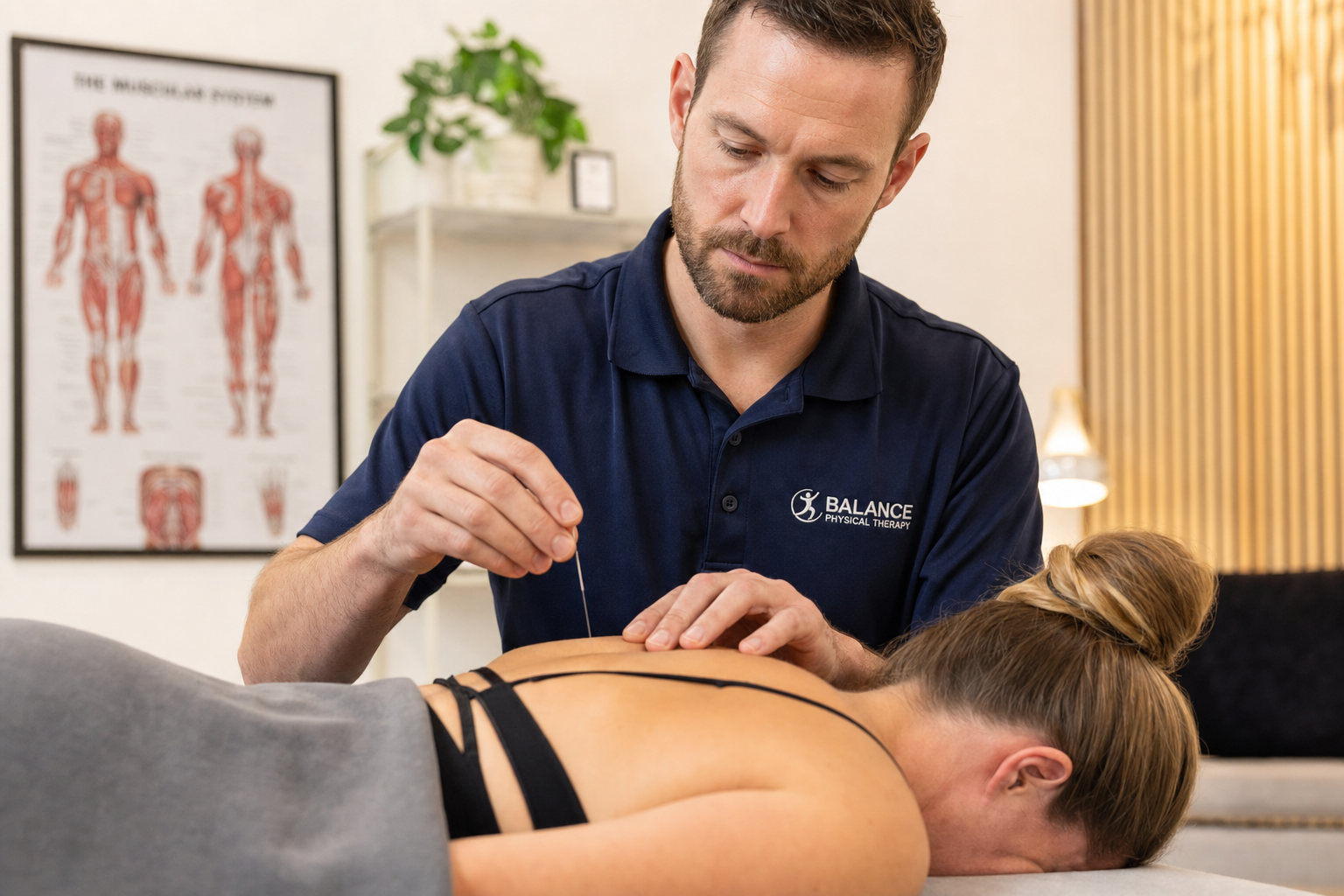
What this is
A thin, sterile, single-use monofilament needle inserted into a specific muscle to change how that muscle behaves. No medication and no injection, the needle itself is the treatment. It is used to reduce trigger point pain, restore range of motion, and reduce muscle guarding that is limiting how you move.
It is not acupuncture. Acupuncture works from a traditional Chinese medicine framework of meridians and energy flow. Dry needling works from Western anatomy and neurophysiology: I am targeting a specific muscle, a specific trigger point, or a specific tendon because of what the exam found.
Who this is for
- Persistent muscle knots and trigger points that massage and stretching keep temporarily relieving but never resolve.
- Range of motion that is limited by muscle guarding rather than by joint structure.
- Tendinopathy: chronic tennis elbow, patellar tendon pain, Achilles or gluteal tendon pain.
- Tension headaches and neck pain with clear trigger points in the upper cervical and shoulder muscles.
- Athletes with tight, overworked tissue that will not release before an event or a season.
- Low back pain, hip pain, and plantar fascia pain with a strong muscular component.
Dry needling works best as one tool inside a plan, not as the plan itself. Needling can open a window where a muscle moves and loads better. Loading that muscle correctly is what makes the change stick, which is why I always pair it with exercise.
What to expect
- Consent and screening first. I walk you through the procedure and the risks, and screen for anything that makes needling a bad idea for you.
- The insertion itself is usually barely felt. The needles are far thinner than the ones used for blood draws or injections.
- You will likely feel a twitch response. A brief involuntary cramp or grabbing sensation in the muscle. It lasts a second or two. Clinically it is a good sign, and it is the part most people describe as strange rather than painful.
- Expect soreness afterward. Most people feel a deep bruised ache for 24 to 48 hours, similar to a hard workout. Some people feel immediate relief, some feel worse for a day and better on day two.
- Then we load it. Every session ends with movement or exercise so the change you just got is actually used.
Come hydrated, having eaten something, and in clothing that lets me reach the area being treated. Do not schedule needling the day before competition until you know how you respond.
Does it hurt?
The honest answer is that it depends on the muscle and on you. The needle going in is usually unremarkable. The twitch response is a strong, odd sensation that some people find uncomfortable and some people barely register. The soreness afterward is real but mild and predictable. I stop any time you ask me to, and we can always treat fewer sites in a session.
What is included
- Screening and consent, plus a brief reassessment of the area before and after so we can tell whether it actually worked.
- Needling of as many sites as are clinically appropriate for that visit.
- Follow-up exercise or movement work to consolidate the change.
- Aftercare instructions in writing.
- Sterile, single-use needles, disposed of after your session. Always.
Cost, stated plainly
| Option | Length | Cost |
|---|---|---|
| Standalone dry needling session | 30 min | $60 |
| Package of 4 standalone sessions | 30 min each | $220 ($55 each) |
| Added to a training session or follow-up visit | Adds about 15 min | $40 |
| Performed during a Standard or Comprehensive Evaluation | Included at no extra charge |
Scheduling and cancellation policy
- Sessions are scheduled directly with me, typically weekday afternoons, evenings, or weekends.
- Cancel or reschedule with at least 24 hours notice at no charge.
- Less than 24 hours notice, or a no-show, uses the session or is billed at the single-session rate.
- Prepaid packages are valid for 6 months from the date of purchase.
- Packages are non-refundable once started, but unused sessions can be transferred to another service of equal value.
Frequently asked questions
How many sessions will I need?
Most people who respond to needling notice a change within 2 to 3 sessions, and many issues resolve within 4 to 6 alongside the right exercise. If you have had three sessions with no meaningful change, I will tell you it is not the right tool for your problem rather than selling you a fourth.
Who should not get dry needling?
Needling is not appropriate if you are on certain blood thinners, have a bleeding disorder, have an active infection or skin breakdown over the area, are in the first trimester of pregnancy, or have a genuine needle phobia. Some conditions and implanted devices require modification rather than avoidance. We screen for all of this before anything happens.
What are the actual risks?
Most common by far is post-treatment soreness and occasional minor bruising. Rare risks include bleeding, fainting, temporary symptom flare, and, when needling the trunk, pneumothorax. That last one is very rare and is why technique and anatomical training matter. I will explain the specific risks for the specific areas we are treating before we start.
Is it covered by insurance?
Not here, since this site is cash-pay. Some plans do cover dry needling when performed in a billing clinic. If insurance coverage matters to you, see me at CACC Physical Therapy in Parker instead.
Do I need an evaluation first?
Not necessarily. If you know exactly what has been bothering you and you have had needling before, a standalone session is fine. If the problem is new, unclear, or has been going on for months, an evaluation first will get you a better outcome than needling in the dark.
Can I work out afterward?
Light movement, yes, and it is encouraged. Heavy or maximal training the same day is usually a bad idea for the treated area. Give it 24 to 48 hours before loading that muscle hard.
Cash-pay, and why it works this way
Everything on this page is paid directly, not billed to insurance. That is a deliberate choice, not a workaround. It means a full hour of my attention with no prior authorization delays, no visit caps set by a third party, and no treatment decisions shaped by what a payer will reimburse. You know the cost before you walk in.
If you would rather use your insurance benefits, that is a completely reasonable choice and I can still help. I see insurance-based patients at CACC Physical Therapy in Parker, Colorado.
Payment is due at the time of service. I accept card, HSA, and FSA cards. I can provide a superbill on request if you want to submit for out-of-network reimbursement yourself, though I cannot guarantee what your plan will pay.
Ready to start, or still deciding?
The 30-minute consultation is free and carries no obligation. If a different service is the better fit, I will tell you that instead of selling you this one.
More questions? The FAQ page covers logistics, policies, and insurance. You can also read patient success stories or browse the full service list.

