
When a hand has been going numb for months, almost everyone asks me the same question: do I need surgery, or can I sort this out without it? In January 2024 a Cochrane review gathered every randomized trial that has actually tested that comparison, and the answer is more interesting than a simple yes or no.
The study, briefly
This was an updated Cochrane systematic review of surgical versus non-surgical treatment for carpal tunnel syndrome: Lusa et al., Cochrane Database of Systematic Reviews, 2024;1:CD001552. The authors pooled 14 randomized controlled trials with 1,231 participants and 1,293 wrists from nine countries across Asia, Europe and North America. Trials ranged from 22 to 176 people. Participants were 84% women, with mean ages between 32 and 53, and they had been living with symptoms for anywhere from 31 weeks to three and a half years. The literature search ran through November 2022.
Carpal tunnel release surgery was compared against night splinting, corticosteroid injection, splinting plus injection, platelet-rich plasma injection, manual therapy, and mixed non-operative care. The review labeled anything past three months as long-term follow-up, which in practice usually meant 6 or 12 months.
What they found
Start with the number that gets quoted, then look at the numbers that sit underneath it.
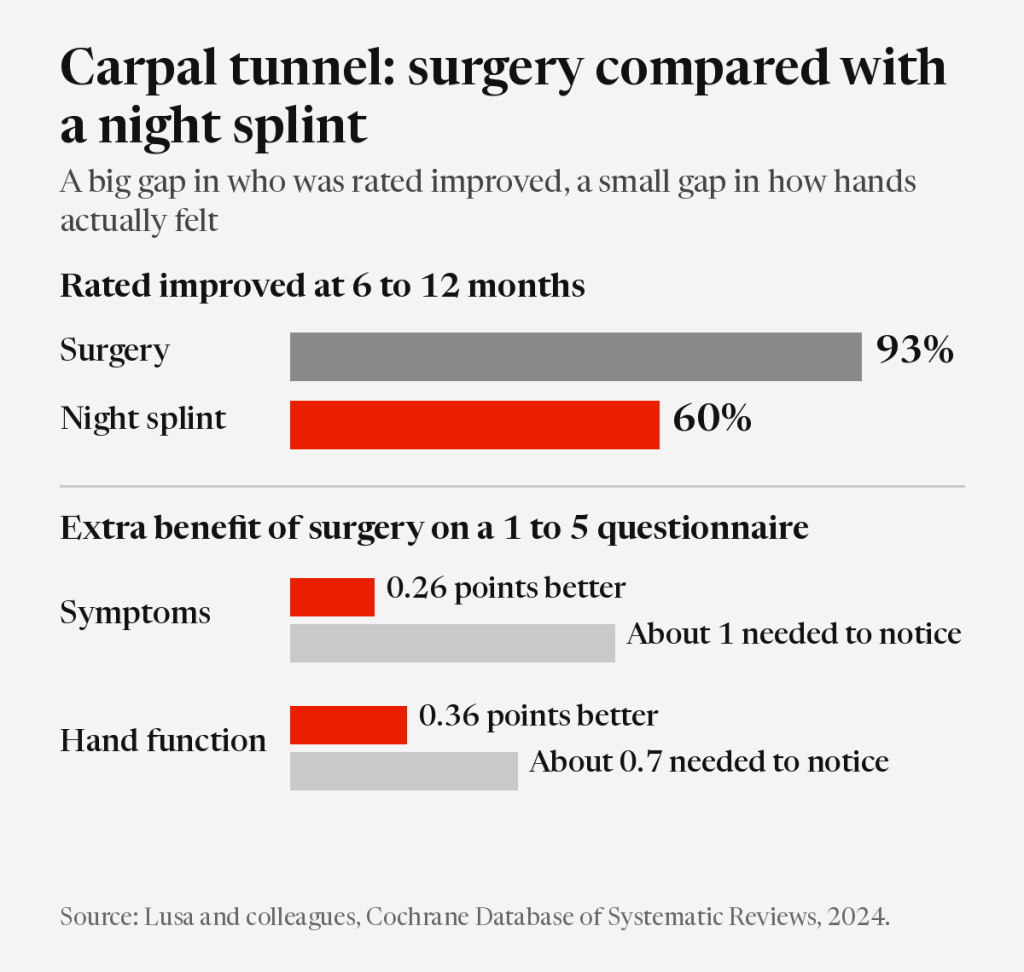
- Surgery roughly doubled the odds of being rated “improved” versus a night splint. At 6 to 12 months, 87 of 94 people (93%) were improved after surgery compared with 70 of 116 (60%) with splinting: risk ratio 2.10 (95% CI 1.04 to 4.24), moderate-certainty evidence, with a number needed to treat of 2. One extra person improved for every two wrists operated on.
- The questionnaire scores barely budged. On the Boston Carpal Tunnel Questionnaire, which runs from 1 to 5, surgery was only 0.26 points better for symptoms (95% CI 0.52 better to 0.01 worse) and 0.36 points better for hand function (95% CI 0.62 to 0.09 better). The change people typically need to feel in order to notice a difference is about 1 point for symptoms and 0.7 for function, so both gaps sit below that line. Quality of life differed by 0.04 EQ-5D points.
- Against a steroid injection, surgery had no clear edge. Rates of clinical improvement, symptom relief, harms and the eventual need for further surgery were all uncertain, and hand function and pain probably do not differ considerably.
- Against manual therapy, surgery produced about 1.6 times the rate of clinical improvement, with no clear advantage on the other outcomes. Adverse effects after surgery were reported in 60 of 98 people (61%) versus 46 of 112 (41%) with splinting, though that comparison was very low-certainty evidence.
The catch
Three limitations matter here, and they pull in opposite directions, which is exactly why this is worth reading carefully.
First, nobody was blinded. You always know whether you have had an operation on your wrist, and that knowledge inflates self-reported ratings of improvement. The “93% improved” figure is a global impression score, which is the outcome most vulnerable to that bias, while the symptom and function questionnaires that showed almost no difference are more anchored to specific daily tasks.
Second, in two of the larger trials up to 40% of people assigned to non-surgical treatment had surgery anyway before the long-term outcome was collected. That crossover usually pushes results toward the middle and can make surgery look less impressive than it is.
Third, there has never been a trial of carpal tunnel release against placebo surgery or against no treatment at all, and there is very little data past a couple of years. So we know surgery beats a splint on the improvement question at one year. We do not know how much of that is the release itself, and we do not know where either group stands at five years.
What this means for you
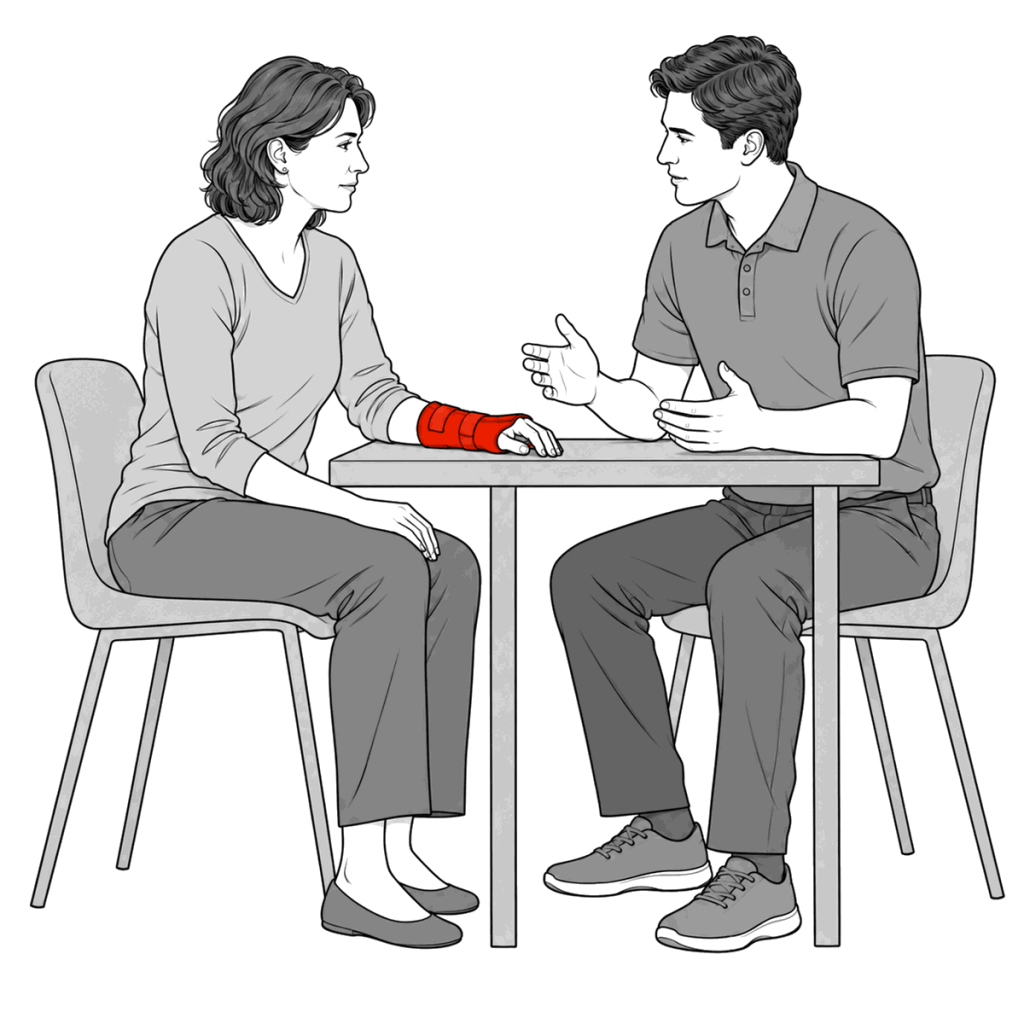
If your symptoms are mild to moderate, this review supports starting conservatively rather than booking an operating room. A night splint is cheap, reversible, and it got 60% of people to “improved” on its own. If it works, you have avoided a procedure. If it does not, you have lost a few weeks and learned something useful.
An injection buys speed, not a different destination. In the INSTINCTS trial, The Lancet, 2018, a single corticosteroid injection beat a six-week night splint on the overall Boston questionnaire at 6 weeks (adjusted mean difference 0.32 points, 95% CI 0.16 to 0.48). By 6 months that advantage was gone (difference 0.06 points, p = 0.499), and a similar share of each group had gone on to surgery: 14.3% after injection versus 11.1% after splinting. Worth knowing if you need relief for a deadline. Not a reason to expect a permanent fix.
Conservative care is also not the same thing as waiting. In a multicentre Australian trial, Lewis et al., Journal of Physiotherapy, 2020, 105 people already waitlisted for a surgical consultation were randomized to either continue waiting or attend a single group session covering education, splinting, and nerve and tendon gliding exercises. By 24 weeks, 59% of the taught group had gone to surgery versus 80% of the waitlist group (risk difference 0.21, 95% CI 0.03 to 0.38). One session of good instruction changed the trajectory for about one in five people.
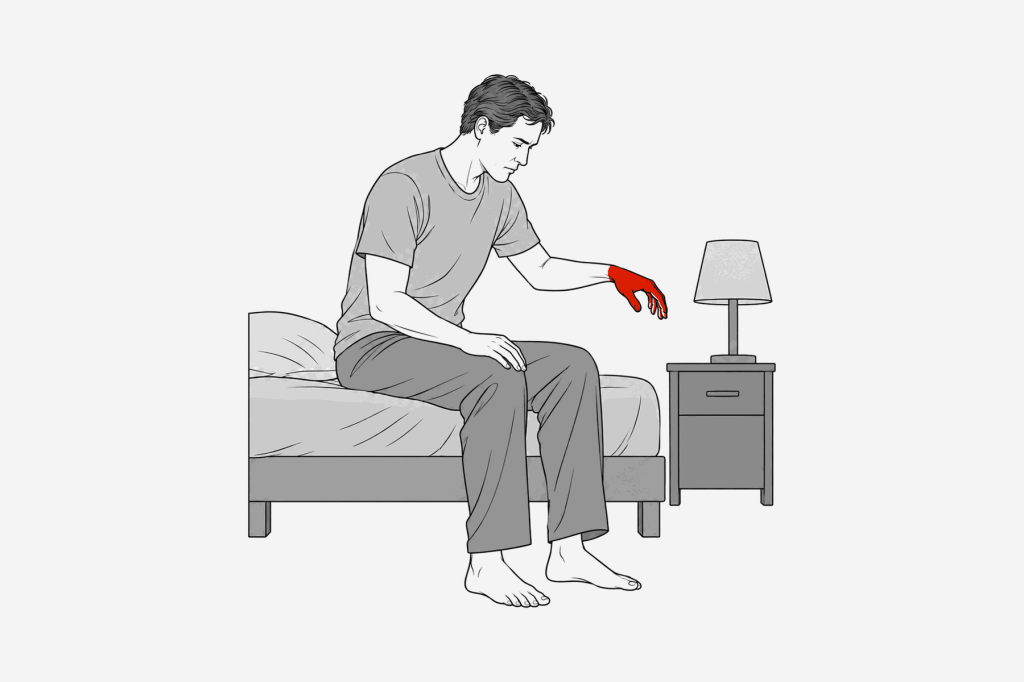
Where I stop recommending patience: constant numbness that no longer comes and goes, visible flattening of the muscle pad at the base of the thumb, or genuine weakness in pinch and grip. Those point to nerve changes that do not reliably reverse, and they belong in front of a hand surgeon rather than in another six weeks of splinting. I walk through those signs, and the first things to actually try, in the companion post on hands that go numb at night.
You will also notice a pattern that shows up across musculoskeletal research: an add-on treatment often wins early and then the curves converge. That happened with injection plus mobilization for frozen shoulder and with the treatment comparison for tennis elbow. Asking “better at what time point?” is usually more useful than asking “which treatment is best?”
Not sure whether to operate?
This is the exact situation a second opinion consult is built for. I will go through your symptoms, your nerve testing if you have had it, and what this evidence says for your particular severity, then tell you plainly whether I think a splint and a loading program is a reasonable first move or whether you should be talking to a surgeon now. No stake in which one you pick.
References
- Lusa V, Karjalainen TV, Pääkkönen M, Rajamäki TJ, Jaatinen K. Surgical versus non-surgical treatment for carpal tunnel syndrome. Cochrane Database of Systematic Reviews. 2024 Jan 8;1:CD001552. https://www.cochranelibrary.com/cdsr/doi/10.1002/14651858.CD001552.pub3/full
- Lewis KJ, Coppieters MW, Ross L, Hughes I, Vicenzino B, Schmid AB. Group education, night splinting and home exercises reduce conversion to surgery for carpal tunnel syndrome: a multicentre randomised trial. Journal of Physiotherapy. 2020;66(2):97-104. https://pubmed.ncbi.nlm.nih.gov/32291222/
- The clinical and cost-effectiveness of corticosteroid injection versus night splints for carpal tunnel syndrome (INSTINCTS trial): an open-label, parallel group, randomised controlled trial. The Lancet. 2018. https://www.thelancet.com/journals/lancet/article/PIIS0140-6736(18)31572-1/fulltext




Leave a Reply