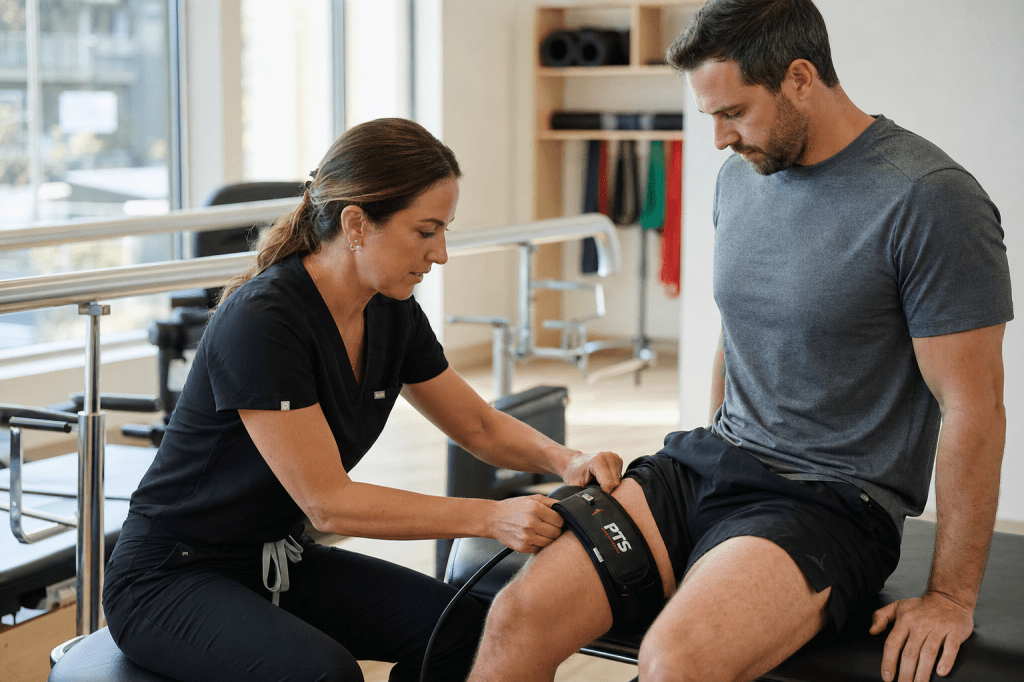
One of the most common questions I hear from patients after knee surgery — whether it’s an ACL reconstruction, a total knee replacement, or a meniscal repair — is some version of this: “When can I actually start building strength again?” It’s a fair question, and the honest answer used to be frustrating: not for a while, and carefully.
That’s changing. Blood flow restriction (BFR) therapy is redefining what early post-operative rehabilitation looks like, and the research behind it has become compelling enough that I use it regularly here at CACC Physical Therapy in Parker, Colorado. Here’s what the evidence actually says.
BFR Accelerates Recovery After ACL Reconstruction
A 2024 meta-analysis published in Arthroscopy by Gopinatth and colleagues analyzed eight randomized controlled trials involving 245 patients recovering from ACL reconstruction. The findings were striking: patients who completed BFR training showed significantly greater isokinetic muscle strength, better pain scores, and meaningfully higher functional outcomes on the International Knee Documentation Committee (IKDC) scale compared to those in standard rehabilitation programs.
To put the functional score difference in plain terms — the IKDC is a patient-reported measure of how well your knee actually works in daily life and sport. A mean difference of nearly 11 points is clinically significant. These weren’t marginal gains.
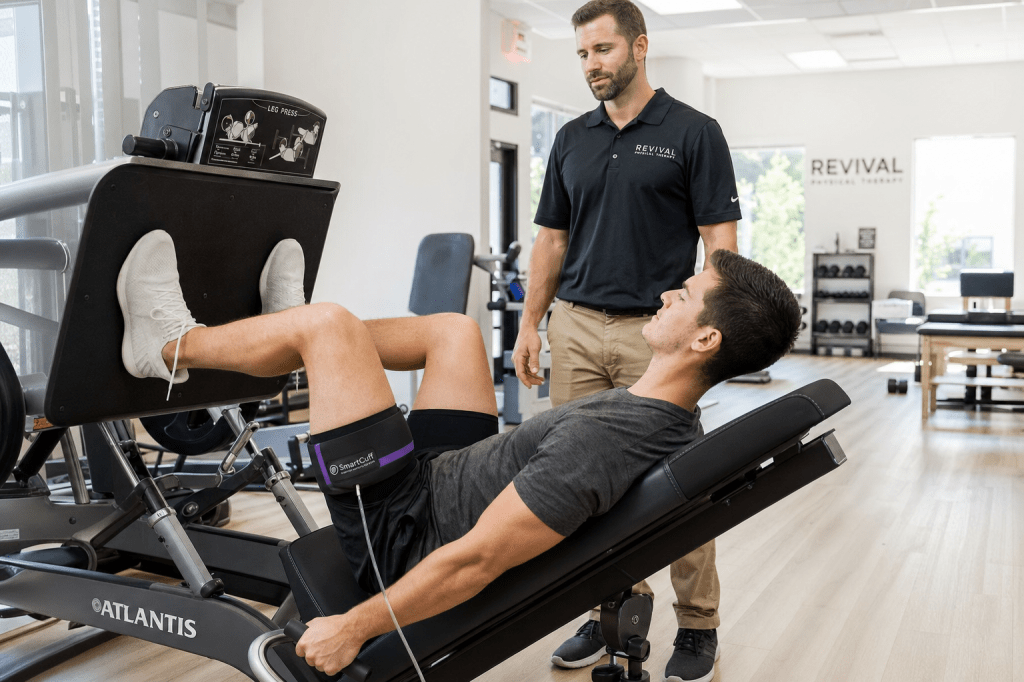
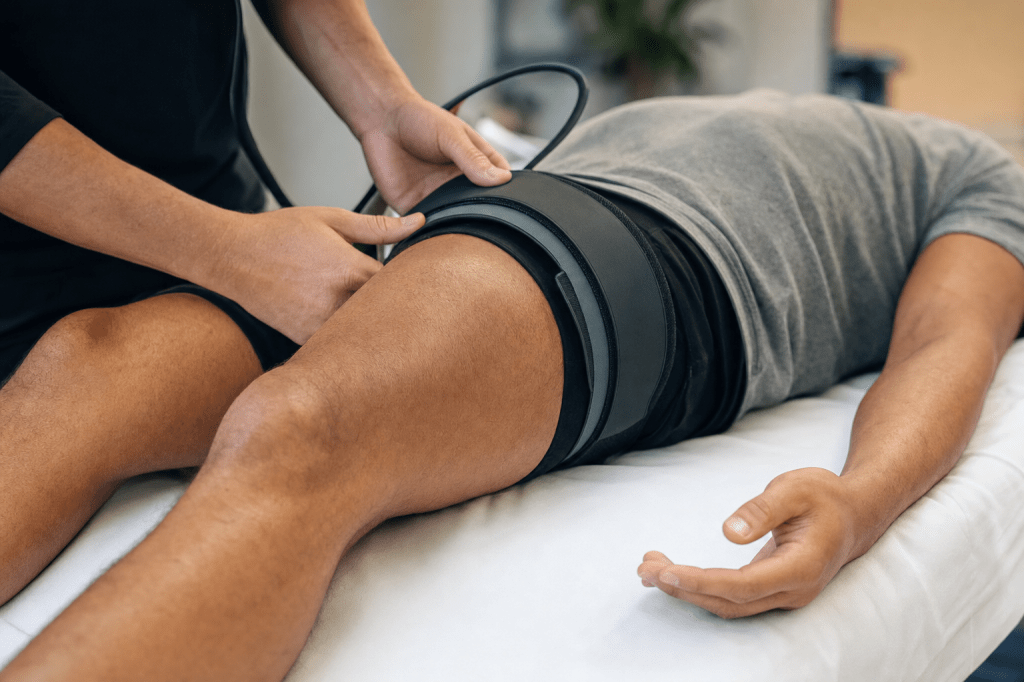
The typical protocol across these studies used 80% limb occlusion pressure over 8 to 12 weeks — meaning blood flow to the working limb is partially restricted using a cuff, forcing the muscle to work harder at lower loads than it otherwise would. For someone who just had surgery and physically cannot tolerate heavy resistance, that’s a meaningful advantage. You get the stimulus for strength and hypertrophy without the tissue stress that would set you back.
Safe and Effective Across a Wide Range of Surgical Patients
A 2024 review in Sports Traumatology & Arthroscopy by Kaya and colleagues broadened the picture considerably. Across 19 studies and 635 patients ranging from age 14 to 70 — covering ACL reconstruction, total knee arthroplasty, meniscal repair, and meniscectomy — BFR training consistently produced significant improvements in strength, knee function, balance, and performance compared to conventional rehabilitation.
What stands out clinically is the age range. Adolescents recovering from meniscal repair and older adults recovering from total knee replacement were both included, and both populations responded well. Low-intensity protocols in the range of 20 to 30 percent of a patient’s one-repetition maximum were used safely throughout. Adverse events were minimal and generally limited to mild, temporary discomfort.
This matters for physicians referring patients to physical therapy. BFR is not a niche technique reserved for elite athletes — it’s a well-tolerated intervention that works across the surgical spectrum, including early post-op, deconditioned, and age-limited patients.
BFR Reduces Pain — And That Unlocks Earlier Progress
Perhaps the most underappreciated benefit of BFR is its effect on pain. A 2025 randomized controlled trial published in BMJ Open by Ladlow and colleagues examined BFR’s capacity to elicit what researchers call hypoalgesia — a measurable reduction in pain sensitivity — even in load-compromised patients.
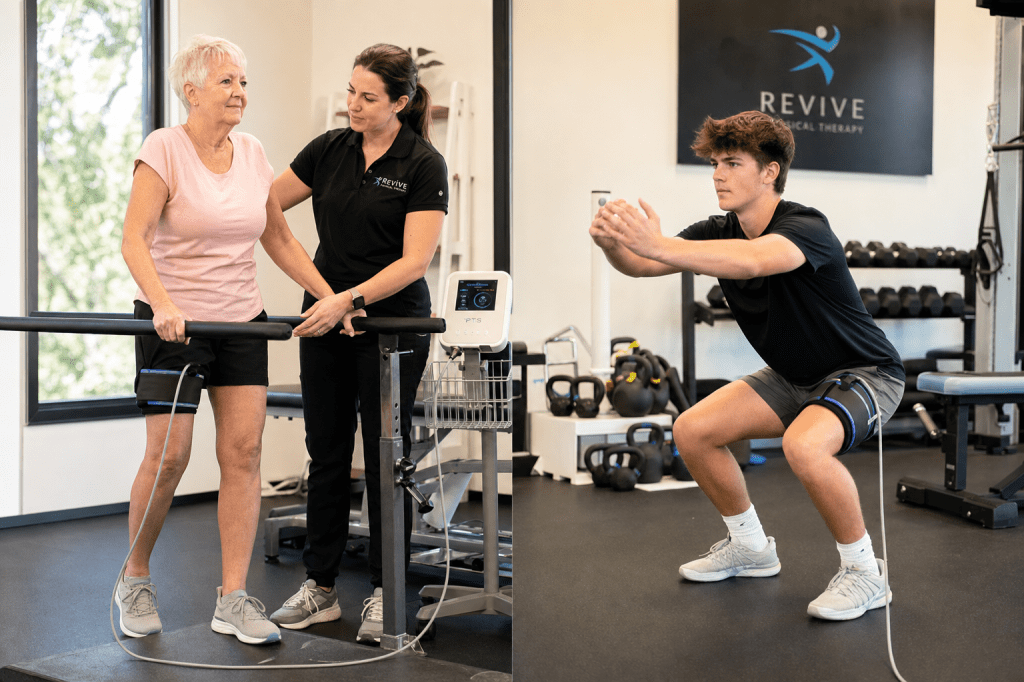
The finding matters beyond any specific population. Patients who can’t tolerate the resistance normally required to drive muscle adaptation can still achieve meaningful strength and hypertrophy gains with BFR, and they do so with significantly less pain than heavier conventional loading would produce. That opens the door to earlier rehabilitation progression, which in turn improves long-term outcomes.
In practice, this means a patient four weeks out from surgery who would otherwise be limited to bodyweight exercises can begin making real physiological progress without aggravating the surgical site or pushing through the kind of pain that signals tissue harm.
The Bottom Line
BFR therapy is one of the better-supported tools in modern orthopedic rehabilitation, and it’s particularly well-suited to the window of recovery when patients need the most gains but can tolerate the least load. The research across ACL reconstruction, knee replacement, and meniscal repair consistently points in the same direction: earlier strength gains, better functional outcomes, and a safety profile that holds across age groups.
At CACC Physical Therapy in Parker, BFR is applied individually — calibrated to each patient’s limb occlusion pressure, tolerance, and surgical timeline — and supervised throughout. It’s not a one-size-fits-all protocol.
If you’re recovering from knee surgery or managing a condition that limits your ability to train at higher loads, reach out to our team at CACC Physical Therapy to schedule a consultation. And if you’re a physician looking to refer patients who would benefit from this approach, we welcome that conversation as well.



Leave a Reply