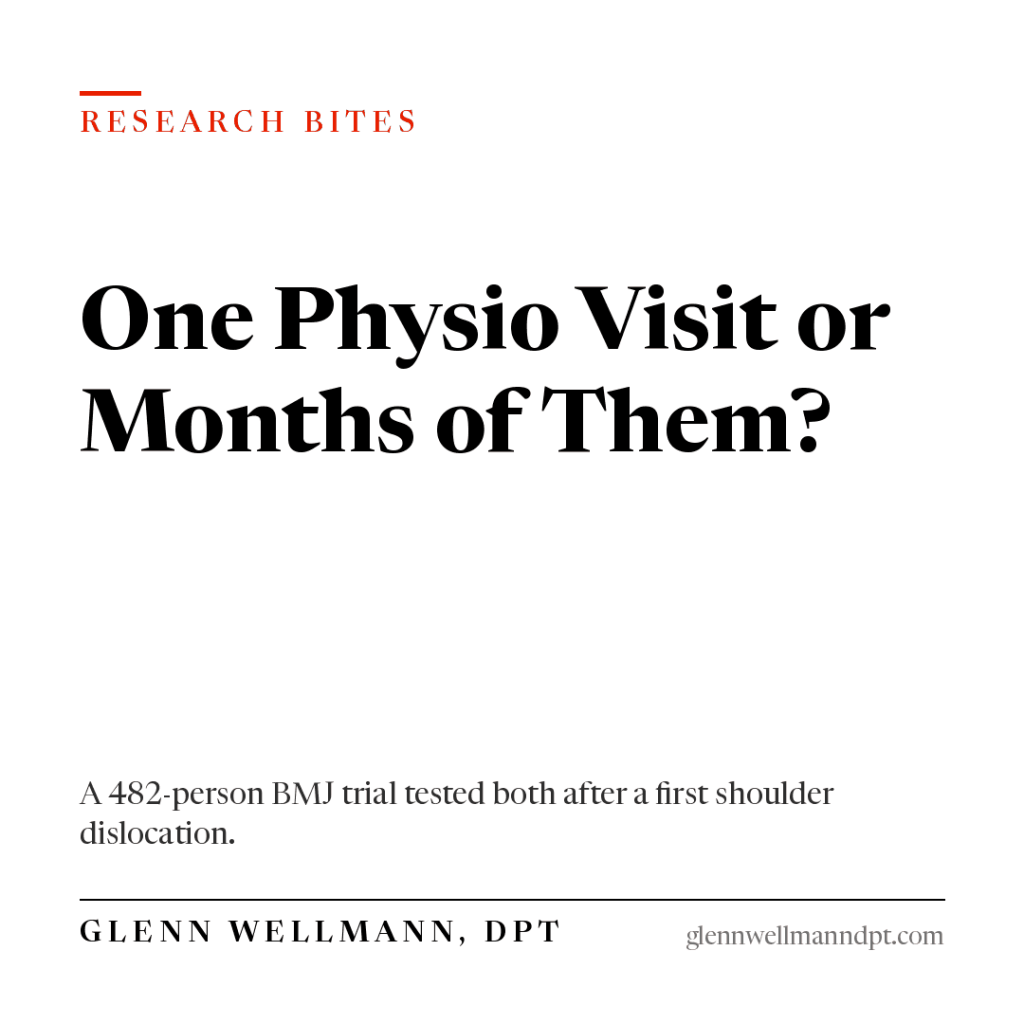
You dislocated your shoulder, someone put it back in, and now you are holding a referral and a question nobody answered clearly: do you actually need months of physical therapy appointments, or is one good session and a home program enough? In 2024 a large British trial set out to answer exactly that.
The study, briefly
The ARTISAN trial was a pragmatic, multicentre randomised controlled trial run across 40 National Health Service hospital sites in the United Kingdom, delivered by 96 physiotherapists (Kearney et al., BMJ, 2024). Researchers enrolled 482 adults who had a first-time traumatic anterior shoulder dislocation, meaning the shoulder came out the front after a real injury, confirmed on imaging, and was managed without surgery. Average age was 45 and two thirds were men.
Everyone got the same starting point: a sling, then a single physiotherapy session within six weeks of the injury. That session was not a brush-off. It included an examination, education about the injury, advice on what to do and what to avoid, and a progressive home exercise program. Half the group (240 people) stopped there, with the option to refer themselves back if they needed more. The other half (242 people) went on to receive additional supervised physiotherapy for up to four months.
The main outcome was the Oxford Shoulder Instability Score at six months, a 0 to 48 questionnaire where higher is better. Before the trial started, the researchers decided that a difference of 4 points would be the smallest difference worth caring about. Follow-up continued to 12 months. This was a superiority trial analysed by intention to treat, which means everyone was counted in the group they were assigned to, whether or not they completed the treatment.
What they found
- The gap was 1.5 points. At six months the extra-physiotherapy group scored 1.5 points higher on the Oxford Shoulder Instability Score (95% confidence interval minus 0.3 to 3.5). That is well under the 4-point threshold the team had set as meaningful, and the confidence interval crosses zero, so it is not a reliable difference at all.
- No difference at any time point. There were no significant differences at six weeks, three months or six months, and no consistent differences in arm function measured by the QuickDASH or in quality of life measured by the EQ-5D-5L.
- Complications were similar in both arms. 22 versus 21 rotator cuff tears, 7 versus 3 re-dislocations, and 3 versus 7 frozen shoulders, with no significant differences. Across the whole trial only 10 of 482 people (2 percent) dislocated again during follow-up.
- The advice-only route was not “no care.” About 18 percent of that group (42 of 240) referred themselves back for physiotherapy, and that door was deliberately built into the study design. Meanwhile, in the extra-physiotherapy arm only 69 percent (167 of 242) finished the full four-month program.
The catch
This is where I want you to slow down before you cancel appointments. By six months, 27 percent of participants had been lost to follow-up, and the people who dropped out were disproportionately young and male. That is precisely the group with the highest risk of dislocating again, so the people whose outcomes would have mattered most are the ones we hear least from.
Follow-up also stopped at six months for the primary outcome and 12 months for some secondary ones, while instability risk after a first dislocation plays out over years, not months. And because the trial included adults of all ages with a mean age of 45, the 2 percent re-dislocation rate is remarkably low compared with what is typically reported in younger athletes. A 20-year-old rugby player and a 55-year-old who slipped on ice are not the same clinical problem, and this trial pooled them.
One more thing worth saying plainly: this study compared a single high-quality physiotherapy session plus a home program against that same session plus more appointments. It did not compare physiotherapy against nothing. Everybody got assessed, educated and given a plan.
What this means for you
In the clinic, this trial changed how I frame the first conversation after a dislocation. The value is front-loaded. What matters most is that first visit being thorough: a proper examination to rule out a rotator cuff tear or nerve involvement, clear guidance on which positions to respect early, and a home program that actually progresses instead of the same three exercises for two months.
Here is how I would use the findings:
- Invest in one excellent evaluation rather than a dozen rushed ones. Ask for time, an exam, and a written plan you understand. If you leave without knowing what you are doing next week and the week after, the visit was too short.
- Then do the program. Consistency at home is the variable you control. Notice that a third of the supervised group did not finish their program either, which tells you adherence is a universal problem, not a personal failing.
- Keep the door open on purpose. Roughly one in five people in the advice-only group came back for more help. That is a normal, expected branch of the plan, not a sign you failed. Pain that is not settling, a shoulder that feels like it wants to slip, weakness, or numbness are all reasons to be seen again.
- Recognise where the exceptions live. If you are young, play a collision or overhead sport, or have already had more than one dislocation, your risk profile sits outside the average of this trial. That is a conversation about return-to-sport testing and possibly a surgical opinion, not a reason to assume a home program will cover it.
If you want a sense of what a progressive shoulder program should look like as it advances, I walked through the criteria-based approach in an earlier post on criteria-based progressive shoulder exercise programs. The principle is the same here: you move forward when you meet a standard, not when a calendar says so.
Where I would start
If your shoulder has been back in place for a few weeks and you are stuck guessing what to do next, that is a solvable problem. A structured home exercise program gives you the thing this trial found actually carried the results: a plan that progresses, written for your shoulder, that you can run yourself. If you would rather have someone put hands on it and test it first, a comprehensive evaluation is a full hour, one on one, and you leave with the plan in writing. If you need care billed through insurance, CACC Physical Therapy is the right door.
References
- Kearney RS, Ellard DR, Parsons H, Haque A, Mason J, Nwankwo H, Bradley H, Drew S, Modi C, Bush H, Torgerson D, Underwood M; ARTISAN collaborators. Acute rehabilitation following traumatic anterior shoulder dislocation (ARTISAN): pragmatic, multicentre, randomised controlled trial. BMJ. 2024;384:e076925. doi:10.1136/bmj-2023-076925. https://www.bmj.com/content/384/bmj-2023-076925


Leave a Reply