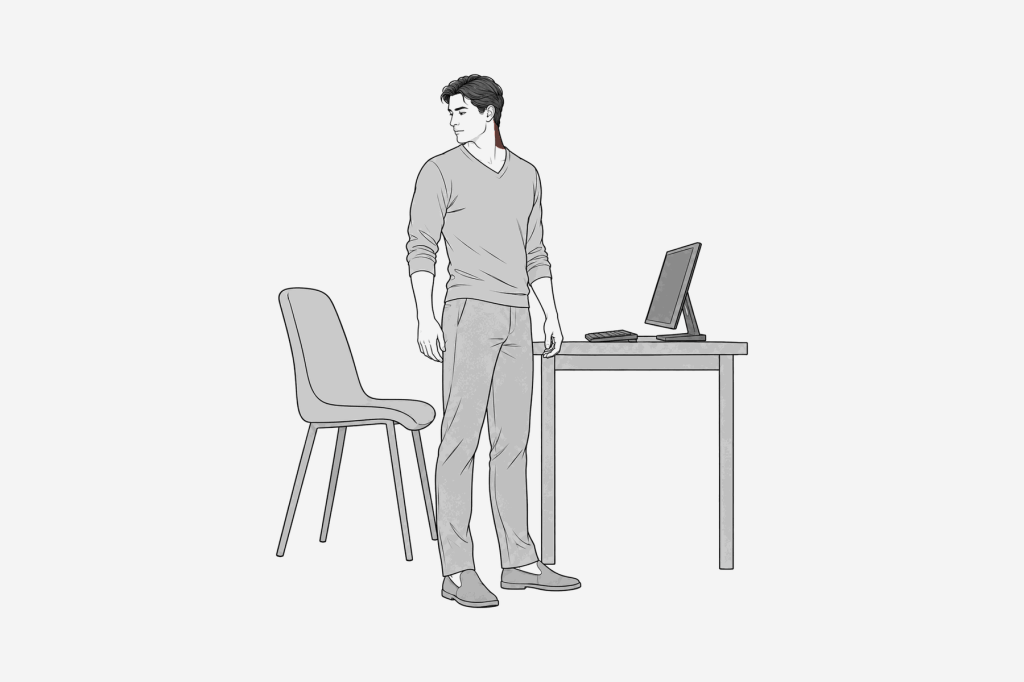
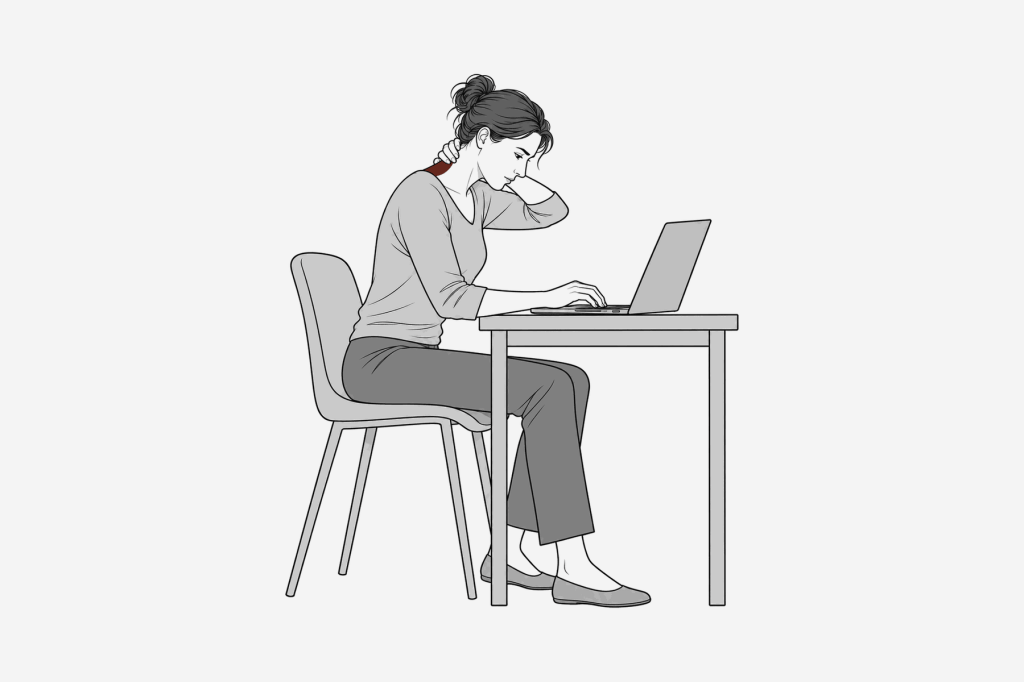
It usually starts as a dull ache across the top of your shoulders somewhere around 2 p.m. By the end of the week you are rolling your neck in circles between meetings, the right side feels tight and grabby, turning your head to back out of the driveway is annoying, and you have started to wonder if you have wrecked your spine by sitting at a desk for fifteen years.
You have not wrecked your spine. In the clinic this is one of the most common things I see, and it is also one of the most misunderstood. Desk-related neck pain tends to feel worse than it is, and most of the advice people have absorbed about it (sit up straight, your head is too far forward, your posture is destroying you) has surprisingly thin evidence behind it. Meanwhile the thing that does have evidence behind it is the thing almost nobody is doing.
What it usually feels like
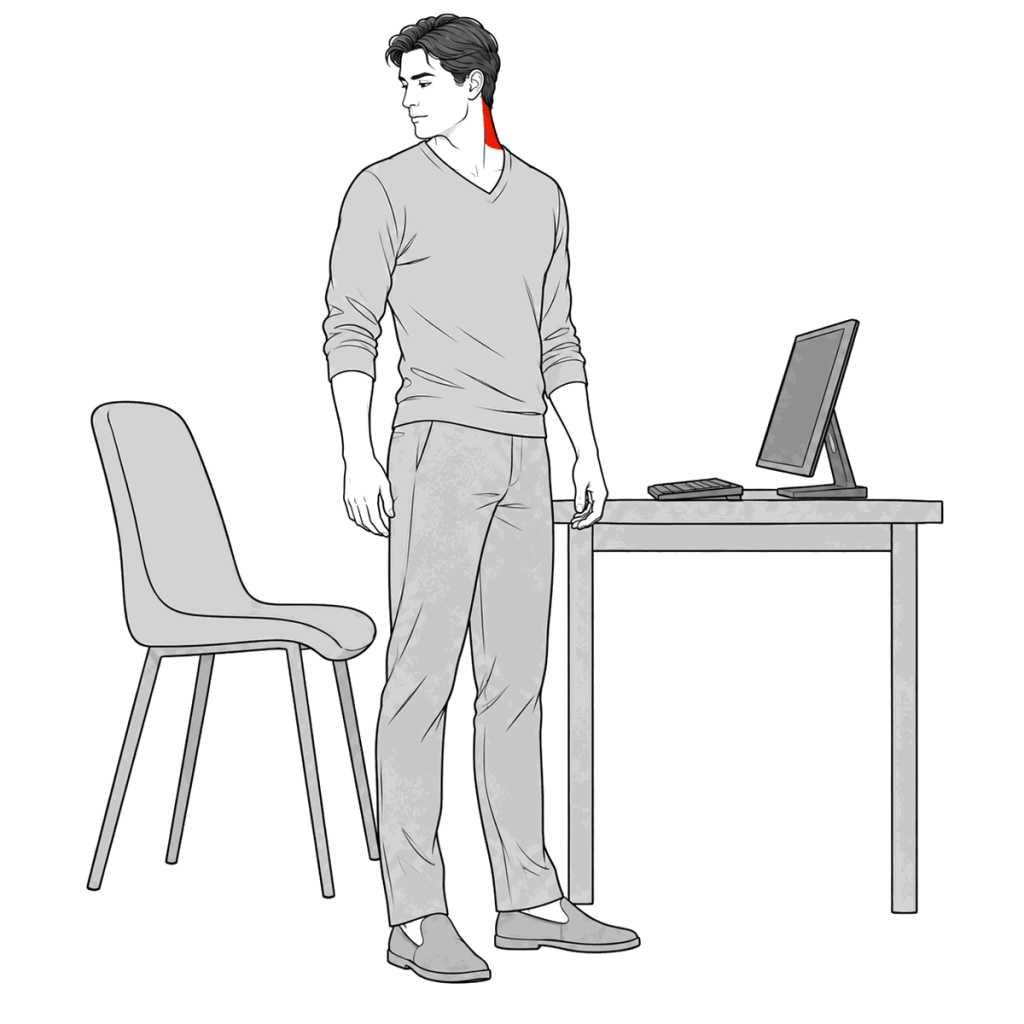
Garden-variety desk neck pain has a recognizable pattern:
- Aching or burning between the base of your skull and the top of your shoulder blade, often worse on one side.
- Builds through the day or the week, better on a weekend or on vacation, worse again by Tuesday.
- Stiff and tight after long stretches of stillness, looser once you move around.
- Sometimes a headache that creeps up the back of your head from your neck.
- Occasionally a crunchy or grinding sound when you turn your head, which on its own is not a sign of damage (I wrote about that in my joints are making noises, should I be worried).
You are also in enormous company. The most recent Global Burden of Disease analysis put neck pain at 203 million people worldwide in 2020, with a global prevalence rate that has barely budged since 1990. Whatever is going on, it is not a modern defect unique to you and your standing desk.
Why it happens
The honest answer is that neck pain is usually multifactorial, but the mechanical part is simpler than people expect: your neck muscles are asked to hold your head in roughly one position for hours, at a low but constant effort level, with almost no variation. That is a fatigue problem, not a damage problem. Muscles that are never allowed to change length, contract harder, or rest get irritable. Add poor sleep, a deadline, and low overall neck and shoulder strength, and the same workday that felt fine in March feels awful in November.
Notice what is missing from that explanation: any claim that one specific spinal alignment is the villain. That matters, because chasing alignment is where most people waste their energy.
What the evidence actually says about your posture
Two lines of research are worth knowing here.
First, the posture link is much weaker than the internet suggests. A study of 1,108 seventeen-year-olds sorted them into four measured sitting neck postures (upright, intermediate, slumped thorax with forward head, and erect thorax with forward head) and then looked at who actually had persistent neck pain. There was no significant difference between the posture groups, with odds ratios hovering right around 1.0 and an overall p value of .773 (Richards et al., Physical Therapy, 2016). The forward-head group was not the group in pain.
Second, a systematic review of 26 studies did find a measurable posture difference between people with and without neck pain: the craniovertebral angle was lower in the neck pain group by a pooled average of 2.93 degrees (Rani et al., Indian Journal of Orthopaedics, 2023). Read that number again. About three degrees. That is smaller than the difference between how you sit at 9 a.m. and how you sit at 4 p.m., and because these were cross-sectional studies they cannot tell you whether the posture caused the pain or the pain changed the posture.
So the practical version: posture is worth varying, not worth perfecting. Nobody has shown that holding a particular alignment prevents neck pain, and I have never once found a patient whose problem was solved by being told to sit up straighter.
What the evidence says actually helps
Exercise, and specifically strengthening. A 2024 systematic review and meta-analysis pooled eight randomized trials of exercise in office workers with chronic neck pain and found that strengthening exercise significantly reduced both neck pain intensity and Neck Disability Index scores compared with control, both at p < 0.01 (Jones et al., Applied Ergonomics, 2024).
The honest caveat, which the authors state plainly: all eight trials carried a high risk of bias and the overall certainty of evidence was rated low. So this is not a guarantee. But it is the strongest signal we have, the intervention is free, and the downside risk of getting your neck and upper back stronger is close to zero.
What to do about it
Here is what I actually give people. Three days a week for the strengthening, daily for the movement breaks. Give it six weeks before you judge it.
- Chin nods (deep neck flexor activation). Lie on your back, no pillow. Gently nod as if saying yes with just your head, tucking your chin a half inch toward your throat without lifting your head off the floor. Hold 10 seconds, relax 5. Do 10 reps. Form cue: this should feel like a small, quiet effort deep in the front of your neck, not a big crunch. If the front of your throat is straining, you are pushing too hard.
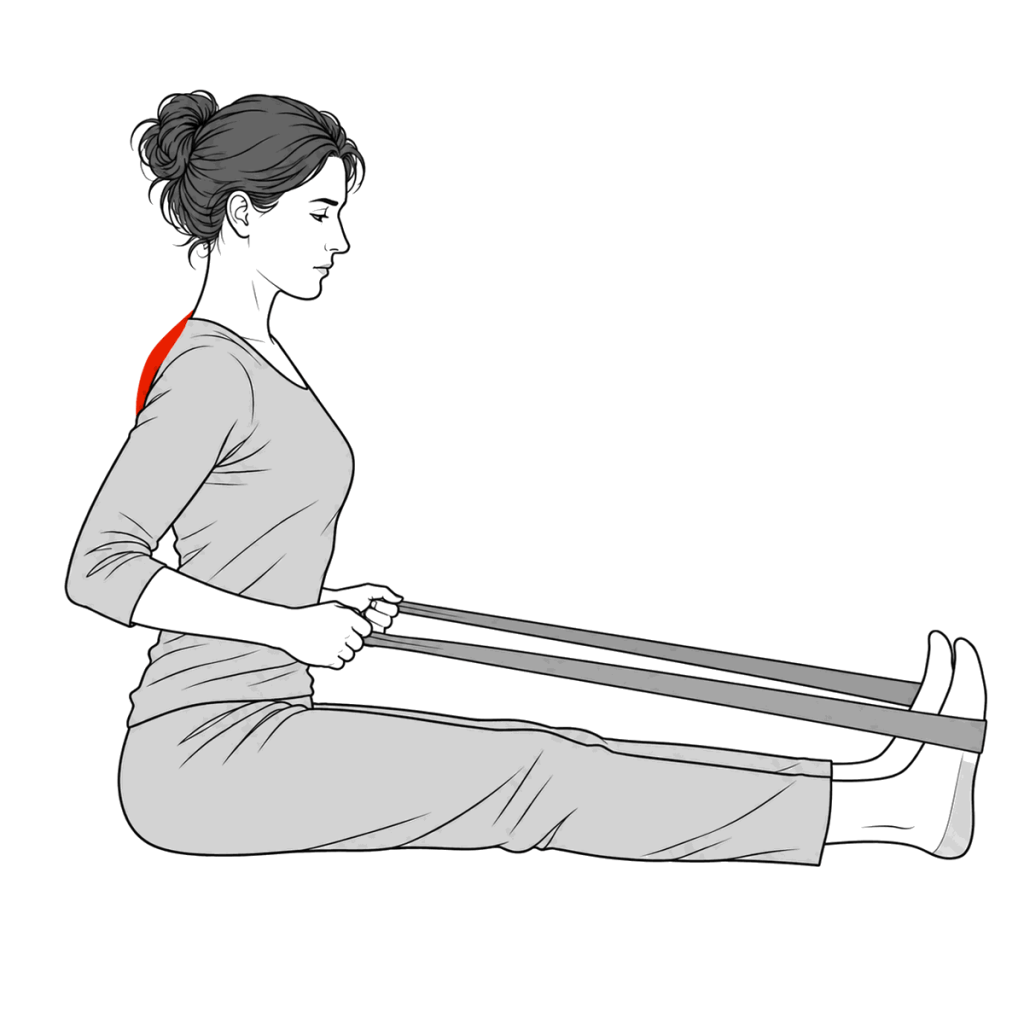
- Prone or seated rows. Band, dumbbell, or cable, whatever you have. Pull your elbows back and down, keeping your neck relaxed. Three sets of 10 to 12, at a weight where the last two reps are genuinely hard. Form cue: initiate with the muscles under your armpit and between your shoulder blades, not by shrugging.
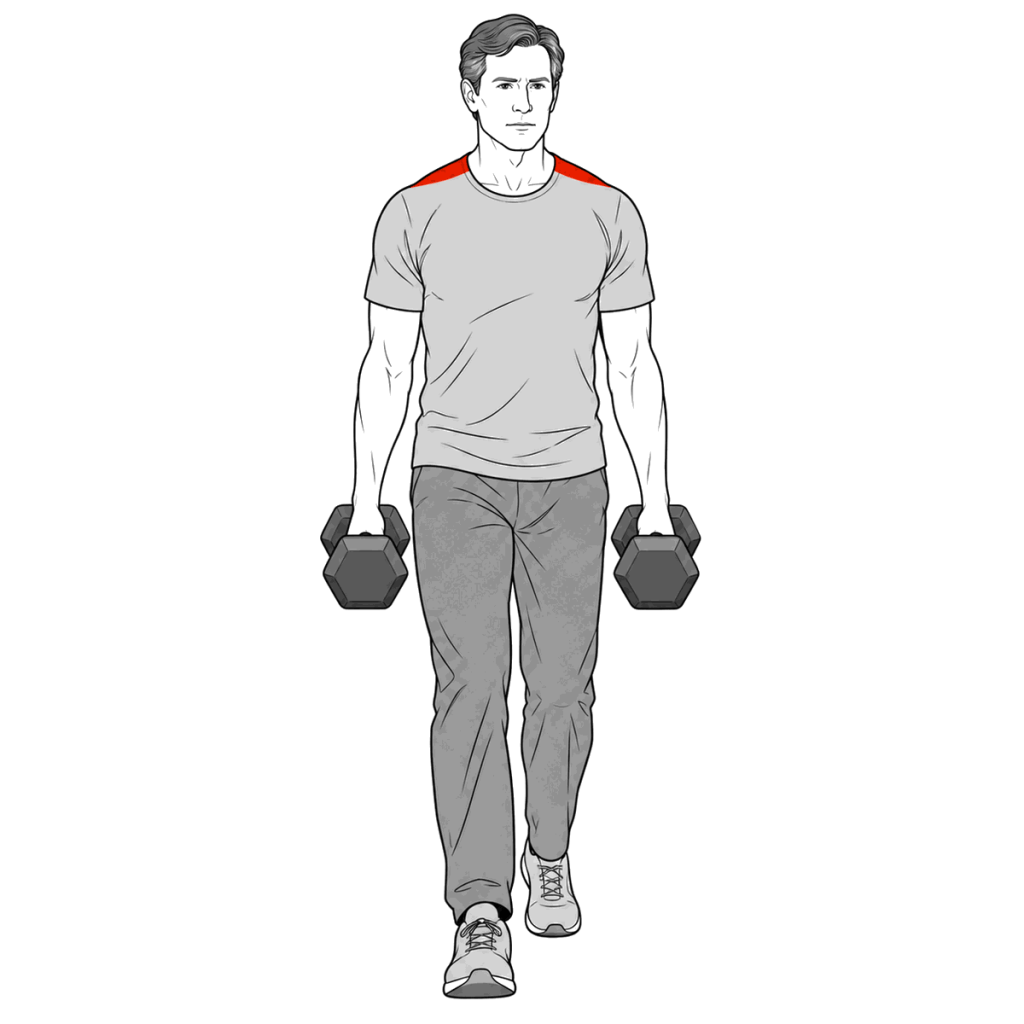
- Shrugs and carries. Your upper traps are not the enemy, they are usually just underprepared. Two sets of 12 shrugs, plus a 30 second heavy carry in each hand. Form cue: full range up, full range down, no rushing.
- Cervical rotation, done often. Turn your head slowly to each side to end range, hold 3 seconds, 8 reps each way. This is mobility maintenance, not a stretch contest.
- Change position every 30 minutes. Not perfect posture, different posture. Stand for a call, lean back for ten minutes, walk to fill a water bottle. The goal is variation and load sharing, and this is the intervention people skip because it feels too simple to matter.
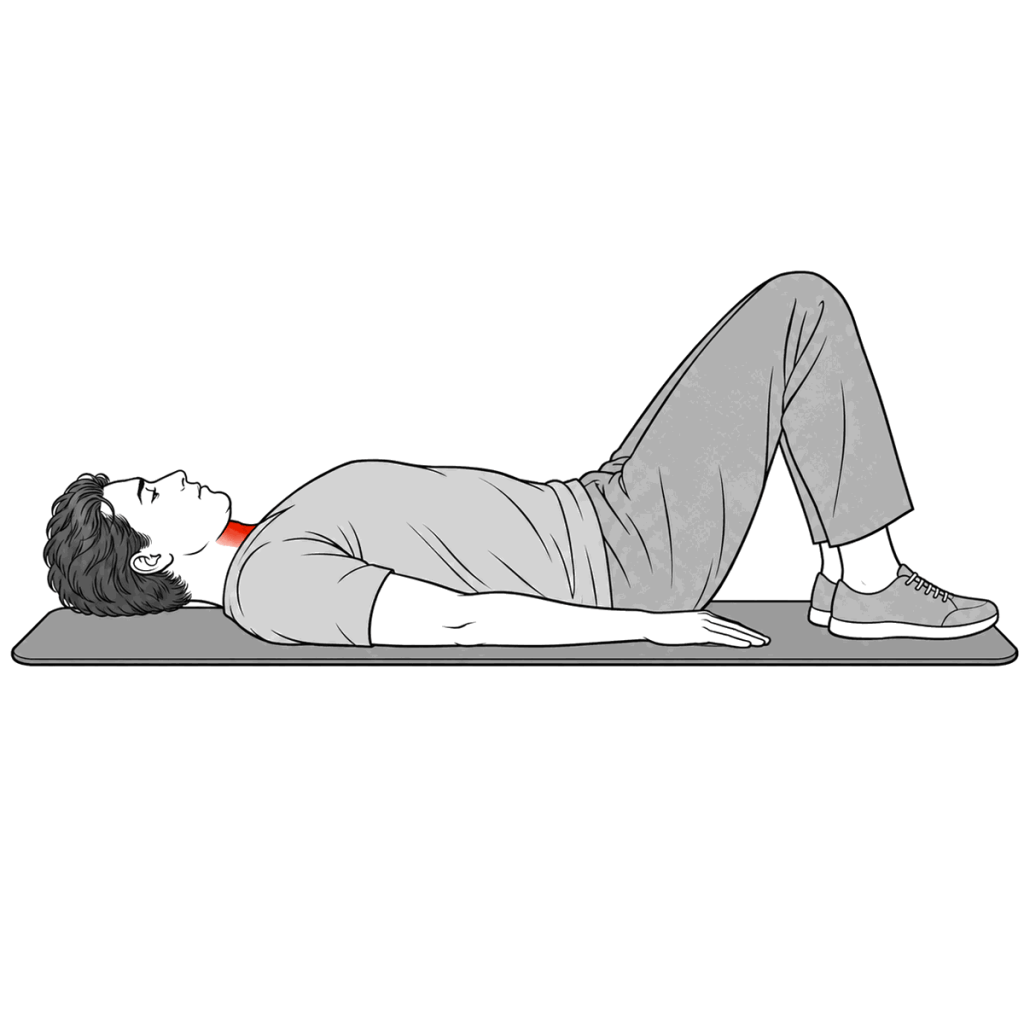
One self-check to track progress: time how long you can hold your head an inch off the floor while lying on your back with your chin gently tucked. Most desk-pain patients start under 20 seconds. If that number climbs over six weeks, your program is working even if pain has not fully resolved yet.
Red flags: when to get it looked at in person
Most desk neck pain does not need imaging or an urgent appointment. These do warrant a same-week medical evaluation:
- Pain, numbness, tingling, or weakness that travels into your arm or hand, especially if you are dropping things or losing grip strength.
- Neck pain after a real trauma such as a car accident or a fall.
- Headache that is new, severe, or different from any headache you have had before, or headache with dizziness, visual changes, difficulty speaking, or trouble with balance.
- Fever, unexplained weight loss, night pain that wakes you, or a history of cancer.
- Clumsiness in your hands or changes in walking, which can suggest the spinal cord rather than a muscle.
If your headaches are the main event rather than the neck ache, that is a specific pattern worth sorting out. I cover how to tell whether a headache is actually coming from your neck in headaches that come from your neck.
Where to start
If you have been managing this with stretches and a new chair for a year and it keeps coming back, the missing ingredient is usually a progressed strengthening plan you will actually follow, written for your schedule rather than pulled off a handout. That is exactly what a home exercise program is for: I build it around your week, your equipment, and your six-week checkpoints, and you leave knowing what to do on the days it flares.
References
- GBD 2021 Neck Pain Collaborators. Global, regional, and national burden of neck pain, 1990 to 2020, and projections to 2050: a systematic analysis of the Global Burden of Disease Study 2021. The Lancet Rheumatology. 2024. https://www.thelancet.com/journals/lanrhe/article/PIIS2665-9913(23)00321-1/fulltext
- Jones LB, Jadhakhan F, Falla D. The influence of exercise on pain, disability and quality of life in office workers with chronic neck pain: a systematic review and meta-analysis. Applied Ergonomics. 2024;117:104216. https://pubmed.ncbi.nlm.nih.gov/38219373/
- Richards KV, Beales DJ, Smith AJ, O’Sullivan PB, Straker LM. Neck posture clusters and their association with biopsychosocial factors and neck pain in Australian adolescents. Physical Therapy. 2016;96(10):1576-1587. https://academic.oup.com/ptj/article/96/10/1576/2870247
- Rani B, Paul A, Chauhan A, Pradhan P, Dhillon MS. Is neck pain related to sagittal head and neck posture? A systematic review and meta-analysis. Indian Journal of Orthopaedics. 2023;57(3):371-403. https://pmc.ncbi.nlm.nih.gov/articles/PMC9941407/



Leave a Reply